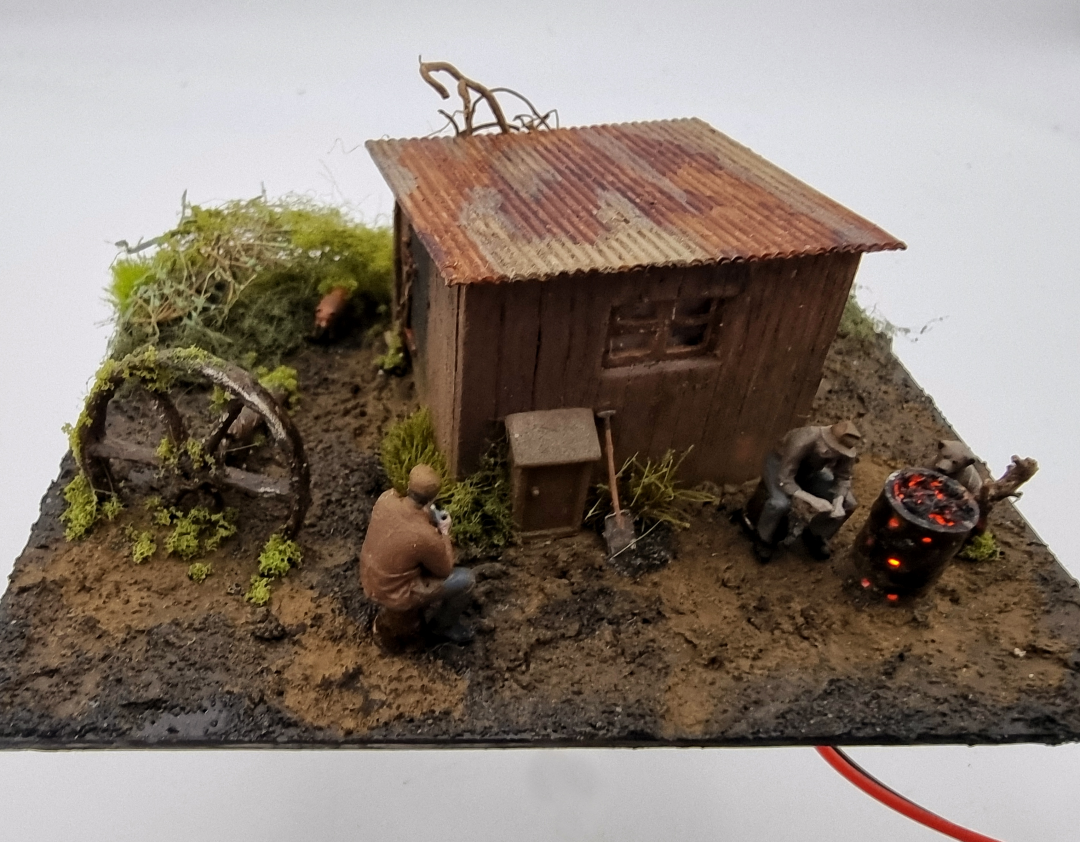
Some layouts feel like collections of models. Others feel like places.
The difference is rarely the amount of detail. Track can be carefully weathered, buildings meticulously detailed, rolling stock researched down to the smallest rivet — and a layout can still feel like a collection of models rather than a convincing miniature world. The layouts that feel most real are rarely the most detailed. They feel real because everything appears connected, interwoven, whole. The stations, buildings, roads and scenery all seem to belong together.
A realistic layout looks as though it has a reason to exist.
The Logic of Place
Look at a real town or industrial area and nothing is accidental. The railway serves local businesses. Roads connect communities. Footpaths form where people actually need to walk.
Real places are products of time, too. Very little remains exactly as it was built. Extensions are added, businesses close, walls are repaired with different materials, and new roads overwrite old routes.
These layers of change give a scene its identity. A station may carry traces of former importance long after the traffic has gone. An old stone warehouse survives beside a modern steel unit. Small differences like these give a scene a history — the impression that life continues beyond the edge of the baseboard.
Connected versus Assembled
There’s a subtle difference between a scene where every element feels connected and one where buildings have simply been arranged around a track plan. One feels complete; the other feels assembled.
It’s why relatively small layouts can often feel more convincing than sprawling ones. A compact scene with a clear identity and purpose evokes a stronger sense of place than a vast layout filled with unrelated features.
The Questions Behind the Scene
When I’m making a layout, much of my time is spent thinking about these connections — not how something will be built, but why it exists at all. If there’s a small halt, where are the passengers coming from, and where are they going? If there’s a mine, how do supplies reach it, and how are materials moved away? If there’s a woodland pond with a jetty, who uses it, and how did they get there?
I’ve spent days on a single scene working through those questions before the first piece of scenic material is laid. The answers are rarely visible in the finished piece. Most people who see it will never consciously notice them — yet I think they notice the result. They feel the atmosphere, even if they can’t immediately explain why one scene feels more authentic than another.
The OO gauge scenery pieces I make carry the same consideration. Each building sits within its own small base, letting the surrounding landscape tell its own story — the vegetation that has crept in at the edges, the debris gathered at the foot of a wall, the slow accumulation of neglect and weather that turns a model into a memory. The moss that has colonised a roof valley, the rust bleeding down from an old gutter bracket, the weeds finding the gaps that maintenance never quite reached. No two pieces share the same history, because no two places ever do.
Beyond the Objects
The physical details still matter, of course. Texture, weathering and careful modelling all contribute. But they have far greater impact when they support a world that already feels believable.
For me, realism has never been about reproducing individual objects. It’s about creating the impression that the railway has a purpose, the buildings have a history, and the landscape carries the quiet evidence of lives lived nearby.
When a scene achieves that, it stops being a model and becomes a place.
There’s a selection of OO gauge scenery pieces in the shop — each one finished, one-off, and built with that intention.