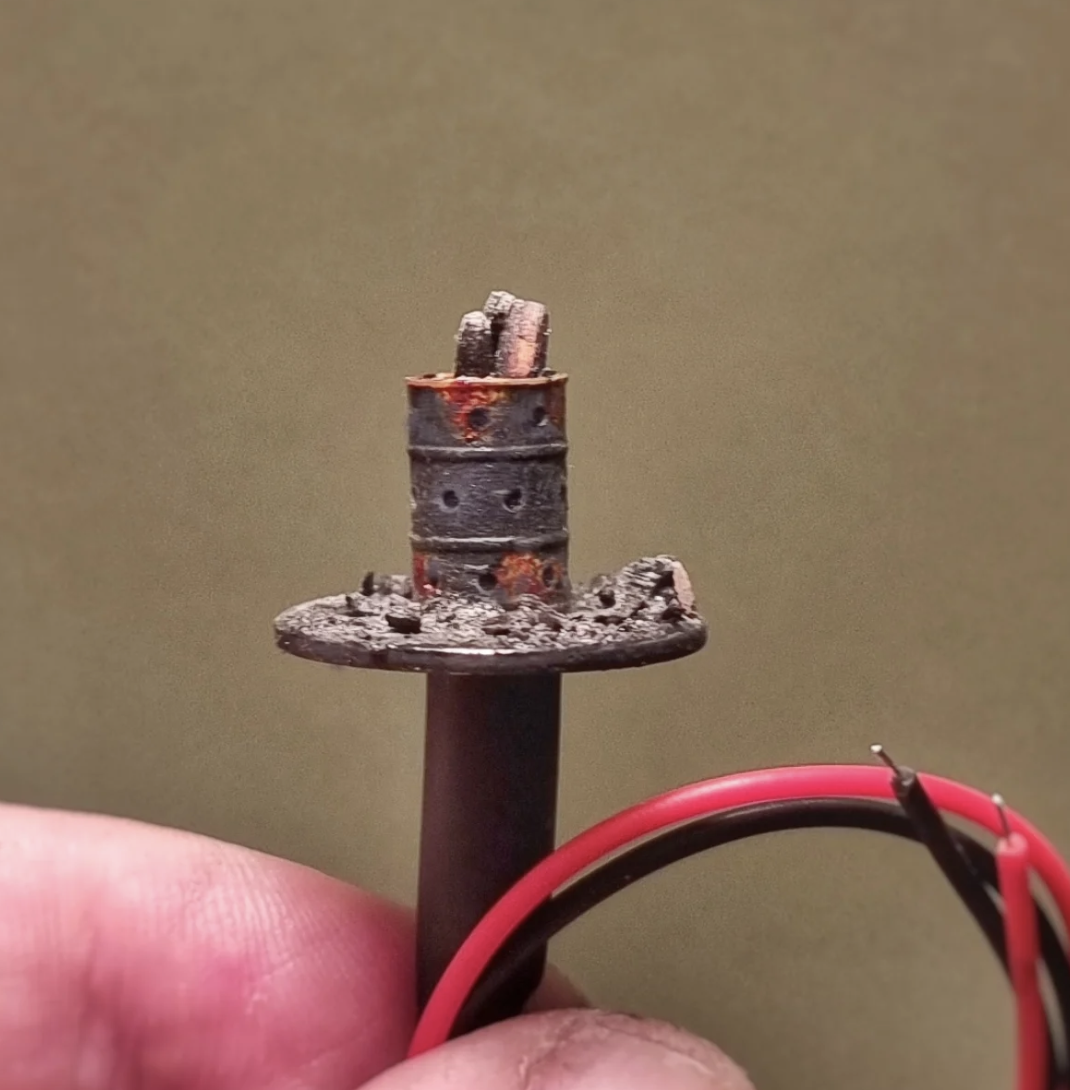
A well-detailed OO gauge brazier occupies very little space on a model railway, yet it often becomes one of those scenic details that rewards a second look and, with its animated flame effect, brings a subtle sense of life and movement to a scene. For many modellers, these small accessories are the final step in a layout — bought only after buildings and track plans are fixed, when attention shifts to the finishing touches that help a scene feel settled into itself. Here, that second look reveals something more: the gentle glow tucked amongst rusted metal, ash and timber.
That was certainly true on my own layouts. Once the track, buildings and major scenery were complete, I found myself turning my attention to the small details that help a scene feel lived in.
At first glance, a brazier seems straightforward enough. A metal container. Some timber. A scattering of ash.
The longer I looked, the less straightforward it became.
Whether viewed as a standalone 1:76 brazier or as part of a wider industrial scene, its contribution to atmosphere often outweighs its physical size. Not because it draws attention to itself, but because it quietly suggests that life has been happening here for some time.
Most of that impression comes from three things: the rust, the ash and the timber.
The rust was the first challenge.
Before finalising the OO gauge brazier, I spent several weeks finding and examining rusty metal and braziers wherever I encountered them. More importantly, I spent time studying the one sitting in my own garden.
From a distance, rust can appear fairly uniform, with dark reds gathering around edges and holes.
Up close, it became difficult to find two areas that looked the same.
Rain affected some surfaces differently from others. Heat left its own marks. Sheltered parts aged differently from exposed edges. Some areas carried the bright orange and dark red tones most people associate with rust, while others were yellow and still others had darkened until they were almost black. New corrosion sat alongside years of weathering.
The more often I looked at it, the less it resembled a single surface.
What struck me most was how different colours and textures combined to create the impression of something that had spent years outdoors, enduring weather, heat and neglect.
It was only through repeated observation that those individual layers began to reveal themselves.
Adding Ash
The ash told a similar story.
The morning after a fire to burn off some logs from my garden, I found myself looking into the brazier and noticing details I had previously ignored. Beneath the pale grey surface were fragments of the previous evening's fire. Small pieces of charcoal remained visible amongst the ash. Some sections appeared undisturbed while others had collapsed inwards as the timber burned away.
Nothing about it looked uniform.
Even after the flames had gone, the remains seemed to record the fire that had produced them.
Looking at the brazier over the course of a few fires, I noticed how each fire added another layer. Fresh ash settled over older deposits. Darker fragments remained visible beneath lighter surfaces. The contents slowly changed from one use to the next, never returning to a completely clean slate.
What initially seemed like a simple by-product of burning timber began to feel more like a record of accumulated use.
Choosing Timber for 1:76 Scale Fire Effects
The timber itself became an unexpected source of fascination.
I've always enjoyed sitting beside a fire and watching it burn. It is one of those things that can easily occupy a whole evening, before I know it hours have gone up in the smoke. Yet when viewed with the brazier in mind, details began to emerge that I had never consciously noticed before.
Timber rarely burns evenly.
One piece darkens quickly while another appears almost untouched. Corners soften. Surfaces crack. The grain remains visible long after the colour has changed. Sections collapse into charcoal while neighbouring pieces continue to hold their original shape.
At any given moment, a fire contains timber at several different stages of its life.
Some pieces are waiting to burn. Some are actively burning. Others have almost completed their journey.
Watching this happen over and over again made it difficult to think of the timber as simply fuel. The individual pieces seemed to carry evidence of where they had been and hints of what would happen next.
That observation ultimately shaped how I viewed the brazier itself.
I now use matchsticks, cut to size and shape for each bit of timber and then individually paint them with blacks, browns and greys; occasionally even burning them with a small lighter to deform them in ways only real flame can.
Individually, none of these details seem particularly important, but together, they create an impression that is surprisingly difficult to define.
That is often the role of smaller scenic details on a model railway. They rarely become the centre of attention. Instead, once placed near a lineside hut, a building site or workshop, they contribute quietly to the feeling that a scene extends beyond the exact moment being depicted.
It is one reason I offer the brazier in my collection. Viewed individually, each brazier is a small detail. Scattered across a layout, they become part of the background rhythm of a working railway environment, appearing beside workshops, sidings and industrial buildings without demanding attention.
The animated glow, from a small flickering LED, contributes to that impression in a surprisingly subtle way. The effect is less about drawing attention to the brazier itself and more about reinforcing the sense that it belongs within a living scene. Like the weathering and the ash, it feels most convincing when it is noticed almost accidentally.
For such a modest object, an OO gauge brazier asks the viewer to believe quite a lot. Not because of its size, but because of everything it quietly suggests. The rust, ash and timber hint at years of use, countless fires and changing seasons. They suggest a history that extends beyond the edge of the baseboard.
And perhaps that is why such a small detail continues to reward a second look.