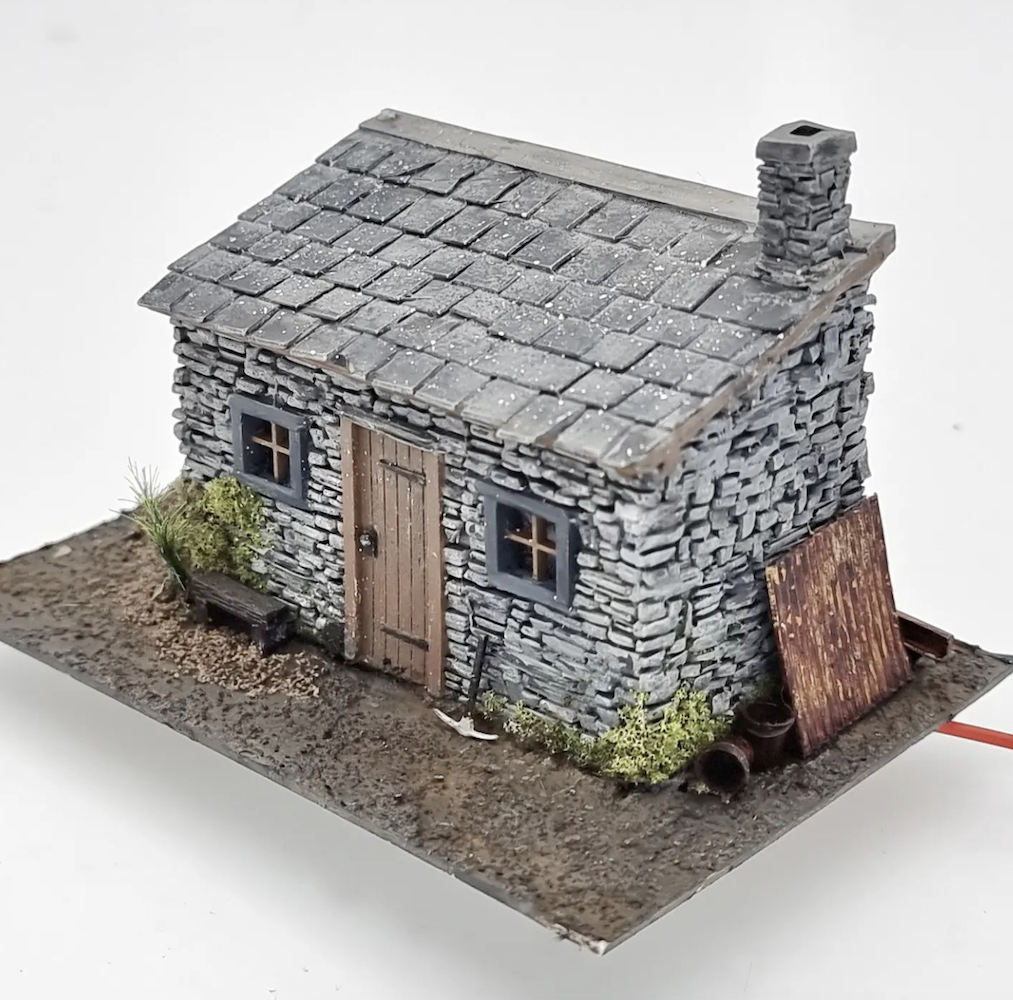
Not far from my workshop in Surrey are the old Chilworth Gunpowder Mills, scattered through the woodland alongside the River Tillingbourne.
The works closed in 1920, and today more than a century of weather and nature has left a mixture of ruined walls, derelict buildings and fragments of more than 100 structures slowly disappearing into the landscape. These weathered, abandoned structures offer something fascinating for miniature makers, a lesson in how buildings genuinely fall into ruin.
Some are still immediately recognisable. Elsewhere, only pieces of brickwork, foundations and other man-made structures rise out of the undergrowth.
Another favourite place of mine is Luxulyan Valley in Cornwall. My son, his partner and my grandson live near St Austell, and when I’m visiting them I often take a wander through the trees and undergrowth to search out new ruins.
It’s a wonderful place for anyone interested in abandoned buildings and forgotten industrial heritage. The woodland contains the remains of Cornwall’s industrial past: old granite workings, tramways, watercourses and ruined structures, with trees, moss and vegetation gradually enveloping what previous generations built.
Luxulyan Valley also has a particular connection with Little World Workshop.
One of the first models I sold was a derelict checker’s hut I’d seen there. I hadn’t originally intended to sell it, but after several people asked if I could make one for them, I began making more.
In many ways, that little ruined building helped start Little World Workshop.
What fascinates me about places like Chilworth and Luxulyan is that the buildings don’t simply look old.
You can see how they’ve become old.
And, perhaps oddly, they demonstrate just how difficult it is to make something look genuinely ruined and abandoned.
The Missing Half Is the Difficult Part
You might think a ruined building would be easier to make than a complete one. After all, half the building is missing.
In practice, that missing half is where much of the difficulty begins.
Although I often include roof timbers, floors and other structural details in intact model buildings, quite a lot of their construction is conveniently hidden. Rafters and battens disappear beneath roof tiles, joists and beams sit beneath floorboards, and the inside of a stone or brick wall is something you rarely see.
Break the building apart and suddenly all of that becomes visible.
Roof tiles fall away to expose battens, rafters and trusses. Collapsed floors reveal joists and beams. Depending on how a wall was built, its broken edge might expose brick courses, irregular stones, rubble infill, fractured plaster or the remains of timbers.
Even parts of a building we normally think of as being indoors can suddenly find themselves outside. A chimney breast or fireplace might remain standing after the surrounding floor and roof have disappeared, alongside fragments of window frames, doorways, guttering and pipework.
If an upper floor has disappeared, there should still be some evidence of where its joists once met the wall. A collapsed roof leaves behind tiles, slates and pieces of timber.
Every missing piece leaves evidence behind.
Ruins Have to Obey Gravity
Ruined buildings aren’t simply random arrangements of broken material.
Something happened to the building, and what remains should make sense as the result.
If a roof collapsed, much of it probably fell inside. If part of a wall came down, rubble should accumulate somewhere beneath it. If a chimney collapsed, its bricks didn’t simply disappear.
And once the roof has gone, previously protected parts of the structure become exposed to the elements, beginning another cycle of deterioration.
So when I’m making a miniature ruin, I often find myself working backwards.
Rather than asking how can I make this look ruined?, I try to imagine what the complete building looked like first.
How was it constructed? What happened to it afterwards? Which parts failed? Where would they have fallen? What might have survived?
Those questions inform both what remains and where I place the debris.
Fire Damage Is More Than Black Paint
Fire makes this even more interesting.
A burnt-out building isn’t simply a normal ruin painted black.
Different materials react very differently to fire. Timber chars, weakens and can disappear almost completely. Brick and stone may survive but become stained, cracked and discoloured. Glass shatters, while pieces of metalwork can bend and warp.
The damage isn’t uniform either.
One part of a building might be devastated while recognisable details survive surprisingly close by. Smoke and soot follow heat and airflow rather than politely covering every wall with an even coat of black.
Again, I find myself thinking about what happened.
Where did the fire start? Which timbers failed? Did the roof fall in? Which walls survived? And where did all that material end up?
Those questions matter because the fire damage, surviving structure and debris should all feel like parts of the same history.
How Nature Reclaims Derelict Buildings
This is something both Chilworth and Luxulyan demonstrate wonderfully. (I've explored this phenomenon in detail elsewhere — how moss, ivy and creeping plants transform a structure over time.)
Once a building is abandoned, damp gets in, debris accumulates and vegetation begins to reclaim it.
But the materials themselves deteriorate at different rates.
The granite structures of Luxulyan can remain remarkably solid long after abandonment, even as woodland grows around them.
At Chilworth, brick and mortar age differently. Mortar weathers away, bricks become damaged or loosened, and walls gradually lose their integrity.
Timber follows another path altogether, eventually rotting away and sometimes leaving little more than evidence of where it once joined the surviving masonry.
Each material has its own relationship with time.
Vegetation has its own relationship with the building too.
Abandonment creates new places for plants to establish themselves. Moss settles into cracked mortar and damp masonry, vines and creepers take hold around broken walls and exposed timbers, and weeds push through rubble, floor voids and collapsed foundations.
Given enough time, larger shrubs and even trees can grow in places where they would never have been allowed to establish when the building was in use.
These are details I think about when creating a miniature scene. Moss, weeds and weathering aren’t simply decoration added to make something look older. Where vegetation appears, and what survives beneath it, can tell part of the history of the place.
Capturing a Moment in Its Decay
Time itself matters.
A building that burnt down six months ago should look very different from a cottage that has stood roofless for fifty years.
Timber disappears. Masonry deteriorates. Debris becomes buried. Vegetation establishes itself. Gradually, the sharp evidence of whatever originally happened begins to soften.
So when I create a ruin, I’m not simply trying to make a building look old or abandoned.
I’m trying to capture a particular moment in its decay. And if you have your own story—a place you’ve known that’s since fallen into ruin, or a landscape you’d like to preserve in miniature—bespoke model railway scenery commissions can capture that history and meaning in a handmade scene.
That affects almost everything: the amount of rubble still visible, the condition of exposed timber, how heavily the walls have weathered and how far vegetation has reclaimed the site.
The same principle runs through much of my work.
Whether I’m creating model railway scenery, wargaming terrain or a standalone diorama, I find that realism rarely comes from simply adding more detail. It comes from understanding why those details should be there.
A worn path suggests where people once walked. Vegetation establishes itself where conditions allow it. Rust, water stains, broken masonry and fallen timber are all evidence of something that happened before the moment I’ve chosen to capture.
For me, a miniature scene becomes more convincing when its details don’t simply look realistic individually, but feel as though they belong together.
Knowing When to Stop
Perhaps the hardest part is knowing when to stop.
It’s tempting to add another patch of moss, another broken timber, more rubble, more weeds and more weathering.
But cover every surface and I risk losing the very details that make the ruin believable.
The best ruins, I think, aren’t necessarily those with the most damage or the most detail.
They’re the ones where you can look at what remains and begin to imagine what stood there before, and what happened to it. (This philosophy runs through much of my work — I’ve written elsewhere about how realism rarely comes from simply adding more detail.)
Perhaps that’s why, all these years after making that little checker’s hut from Luxulyan Valley, I still find myself making ruins.
The buildings may be different, but the challenge is much the same:
Trying to make something small and broken feel as though it once had another life.
From the Workshop
The Ruined Cottage
My latest Workshop Original puts some of these ideas into practice: The Ruined Cottage, a fire-damaged, abandoned cottage designed for OO gauge model railways.
Rather than simply making a building that looks burnt and derelict, I wanted the exposed structure, fire damage, rubble and subsequent decay to feel as though they have a reason for being there.
The broken walls reveal the structure beneath. Rafters, joists and other details normally hidden inside the building have become part of what you see. The remains of the roof and timbers suggest what has collapsed, while the debris below provides evidence of where it went.
The fire damage isn’t distributed evenly, and vegetation has begun to establish itself around and within a building that has been abandoned rather than merely damaged.
Like all my Workshop Originals, each Ruined Cottage is individually made and finished in my Surrey workshop.
If you have your own story—a place you've known that's since fallen into ruin, or a landscape you'd like to preserve in miniature—bespoke model railway scenery commissions can capture that history and meaning in a handmade scene.
The Ruined Cottage — £39