Finding OO gauge buildings isn’t difficult. Finding one that looks as though it actually belongs on your railway can be.
Many buildings are supplied as kits, leaving you to build, paint, weather and landscape them yourself. Ready-made buildings remove some of that work, but a perfectly clean, mass-produced building can still look exactly like what it is: a model placed on top of a layout.
At Little World Workshop, I make handcrafted OO gauge buildings and scenery that take a different approach. Each piece is individually built and finished in my Surrey workshop, with the painting, weathering, groundwork and vegetation already done.
Rather than simply giving you a building, the aim is to create a small piece of railway landscape that looks as though it has been there for years.
For many modellers, building kits is part of the pleasure of the hobby. It’s how I started all those years ago. But not everybody wants to construct, paint and weather every single building on their railway.
And even a ready-made building can need more work before it really feels part of a layout.
Grass needs to meet the walls. Paths need to lead somewhere. Weathering should make sense. Bushes, weeds and other vegetation need to look as though they’ve grown around the building rather than been scattered around it afterwards.
That’s the part I do for you.
My OO gauge buildings are supplied fully assembled, painted, weathered and scenically finished, ready to place on your railway with minimal additional work.
They’re made for modellers who want something distinctive and realistic without turning every new piece of scenery into another project.
I make a small range of OO gauge buildings and structures as part of my Workshop Originals collection.
It’s deliberately a small range. These aren’t mass-produced buildings coming off a production line by the thousand. Each is made individually, with natural differences in weathering, vegetation, groundwork and finish.
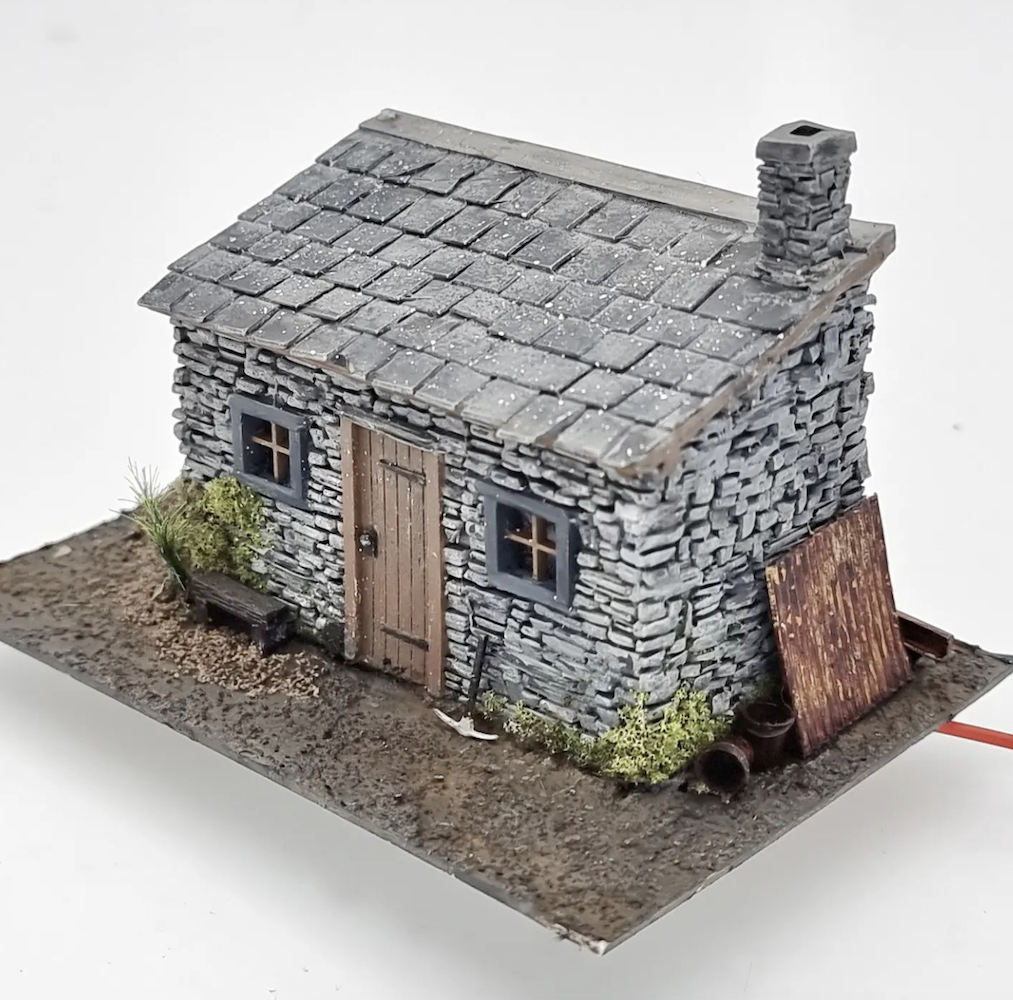
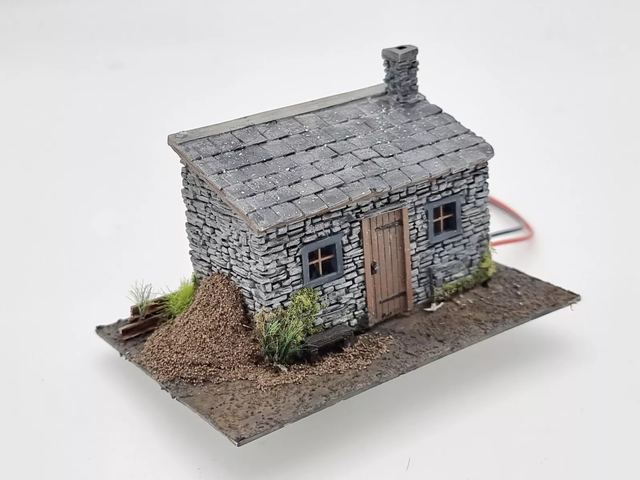
This weathered stone lineside hut is surrounded by bushes and natural vegetation, with a flickering light inside suggesting someone is still at work long after the daylight has begun to fade.
Rather than supplying the hut on its own, I’ve built the structure and its surroundings as one finished scene. The groundwork, vegetation, painting, weathering and lighting have all been done before it leaves my workshop.
Its compact footprint also makes it useful for quieter stretches of railway, branch lines, sidings and goods yards where a larger building might dominate the scene.
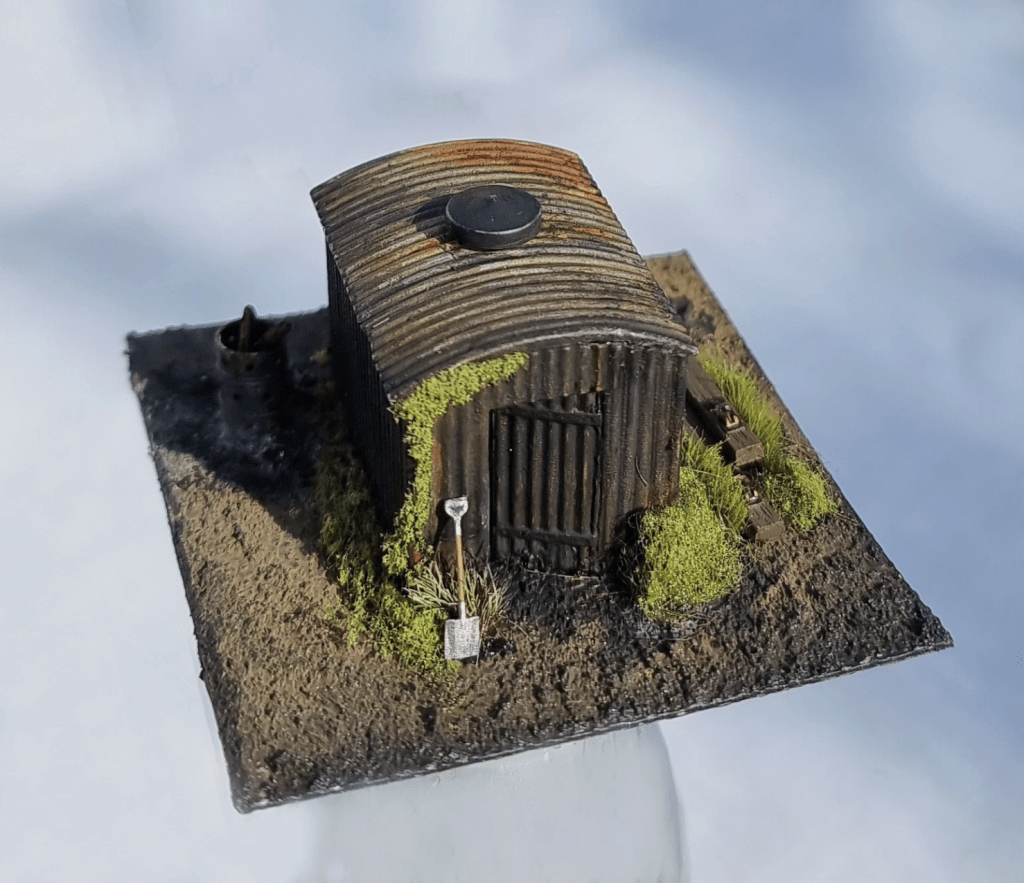
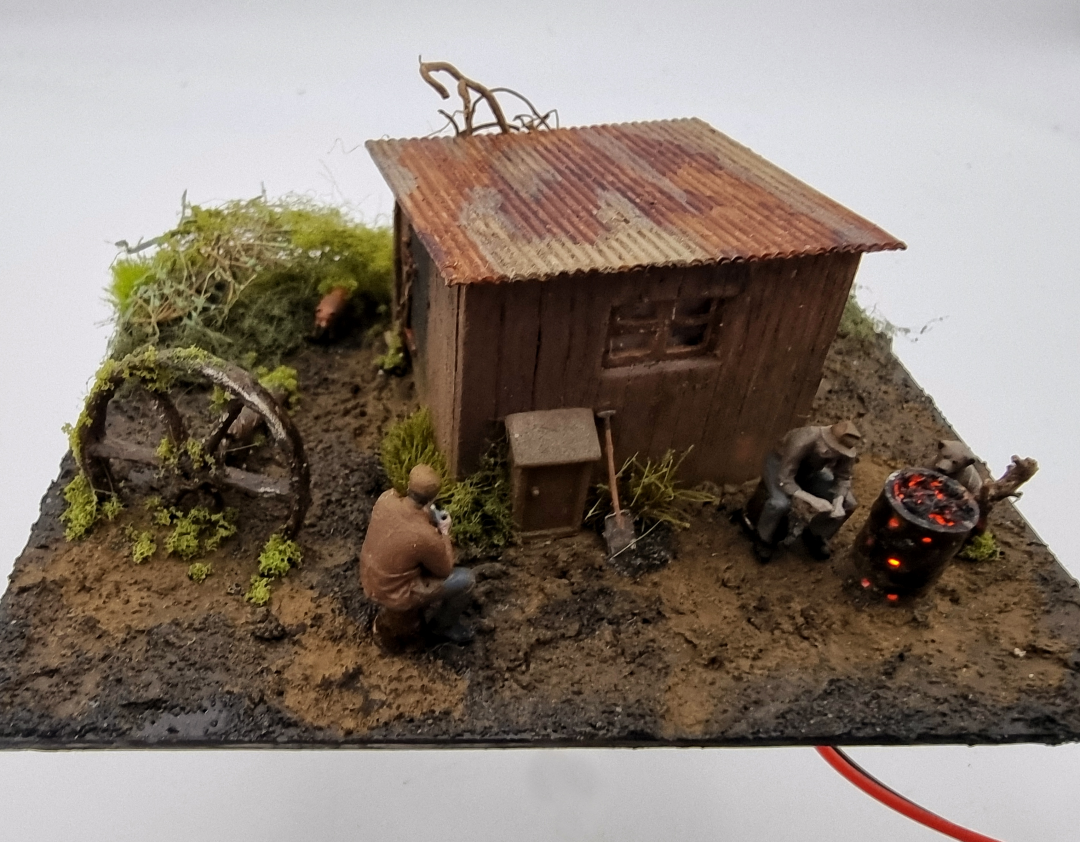
A weathered corrugated hut with a rusted brazier glowing beside it, its flickering flame hinting that a gang is still at work as the light fades and the cold sets in.
It belongs in the busier, working parts of a layout, the goods yard, the platelayers’ corner or a stretch of siding where the everyday life of the railway carries on. Like the lineside hut, it’s built as a small scene rather than a bare structure: the hut, the fire, the ash and the ground worked around them are all finished together.
The flame effect is wired and tested before it leaves the workshop, so there’s a point of life and movement in the scene rather than one more static building sitting on the baseboard.
A closer look at the kind of weathering, groundwork and small details that go into each building.
It isn’t necessarily the building with the greatest number of tiny details.
The difference between a model that looks convincing and one that still looks like a model is often much subtler.
Real buildings have a relationship with the landscape around them.
People walk along particular routes. Water runs off roofs and collects in particular places. Timber fades. Metal rusts. Grass grows longer where nobody regularly walks. Moss and climbing plants establish themselves gradually rather than appearing randomly across a wall.
A building also has a history. Something that has stood beside a railway for 40 years shouldn’t necessarily look as though it was built yesterday.
That’s why I think of my buildings as small scenes rather than isolated structures.
I’ve written more about this idea in Building a Realistic Model Railway: It’s Not About Adding More Detail, looking at why connection, purpose and history often create more realism than simply adding more things.
Weathering isn’t simply about making a building dirty.
A well-kept station building, an old lineside hut and a derelict industrial shed might all have stood outside in the British weather for decades, but they shouldn’t look the same.
Age, maintenance, materials and location all leave different marks.
The aim isn’t therefore to make every OO gauge building look old and neglected. It’s to give it enough variation and imperfection to suggest where it is, how it’s used and how long it might have been there.
That’s also why every Little World Workshop building is individually painted and weathered rather than finished to an identical pattern.
One of the easiest ways for a model building to look artificial is the join between the structure and the landscape.
In the real world, that boundary is rarely perfect.
Grass reaches the bottom of walls. Weeds appear in undisturbed corners. Moss establishes itself in damp places and bushes gradually spread into unused ground.
Over time, the building and its surroundings begin to merge.
It’s something I explore in The Magic of Greenery: How Little World Workshop Huts Use Vegetation to Tell Time. The vegetation around my buildings isn’t simply there to make the model greener; it’s part of suggesting how long that structure has occupied its little piece of landscape.
That’s why many of my OO gauge buildings include their own groundwork and vegetation. You’re getting the building and the beginning of its surroundings together.
There’s no single best type of OO building. What matters is what you want from it.
If you enjoy building, painting and weathering structures, a kit gives you the freedom to make the finished model your own.
If you’d rather concentrate on the railway itself, a finished building removes much of that work.
Little World Workshop buildings fall firmly into the second category. They’re designed to arrive complete rather than becoming another job on your workbench.
Look at the footprint, not simply the scale.
A large station or engine shed can consume an enormous amount of layout space. Smaller huts, sheds and lineside buildings can add character to awkward areas where there simply isn’t room for something substantial.
A small building beside a siding, at the edge of a goods yard or tucked alongside the railway can sometimes contribute more to a scene than a much larger structure squeezed into the wrong space.
Think beyond the building itself.
A hut standing alone on perfectly flat grass tells you very little. The same hut beside a worn path, surrounded by established vegetation and with a few carefully chosen details can begin to suggest who uses it and why it’s there.
Those details don’t have to be numerous.
My article OO Gauge Brazier for Model Railways: Looking Closer at the Details looks at this on a much smaller scale. A little rust, timber, ash and firelight can imply human activity without filling a scene with unnecessary detail.
Little World Workshop is a small working miniature workshop in Guildford, Surrey.
I make each piece individually rather than manufacturing large batches of identical scenery.
Some structural parts may begin as a casting or 3D print, while others are built from scratch, but that’s only the starting point. Painting, weathering, groundwork, vegetation and the final detailing are all completed individually by hand.
That means two examples of the same building won’t be absolutely identical.
Vegetation follows a slightly different path. Weathering varies. Colours and textures shift subtly from one piece to another.
That’s intentional.
Real places aren’t perfectly uniform, and I don’t think miniature ones should be either.
The OO gauge buildings on this page form part of my Workshop Originals scale model scenery range.
Workshop Originals are my own established designs, individually made and finished by hand. They’re for modellers who want distinctive, finished scenery that can be added to a layout with minimal additional work.
If you’re looking for a particular building, real location or something designed specifically around your railway, that’s a different service.
I also undertake a limited number of bespoke model railway scenery commissions, where the building or scene is designed around your available space, chosen period, location and the character of your particular layout.
Excellent quality… fantastic value for the amount of work it took to make and in appearance it looked like the real thing.
Verified eBay buyer
Very good product very pleased. Well recommended seller. Good communication. I would buy again.
Verified eBay buyer
Excellent product by talented model maker… appearance is great… Good value for a well made product.
Verified eBay buyer
Good quality, work well, very realistic.
Verified eBay buyer
OO gauge is the most widely used model railway scale in Britain. OO models are made to approximately 4mm to 1 foot, or 1:76 scale (more precisely 1:76.2).
Standard OO gauge track has 16.5mm between the rails.
Strictly speaking, scale describes the proportion of the model and gauge describes the distance between the rails. In everyday British model railway use, however, “OO gauge” is commonly used to describe the whole scale.
No. Although OO and HO models normally use track with 16.5mm between the rails, they’re different scales.
British OO is approximately 1:76 scale, while HO is approximately 1:87 scale, making HO buildings, figures and vehicles smaller than their OO equivalents.
Some scenic materials can work perfectly well with both scales because trees, rocks and vegetation naturally vary in size. The difference tends to be more noticeable with buildings, where doors, windows, figures and vehicles give the eye familiar references for scale.
Approximately, yes. British OO is more precisely 1:76.2 scale, although it’s normally described simply as 1:76.
Yes. OO is commonly called 4mm scale, meaning approximately 4mm on the model represents one foot in the real world.
Standard OO gauge track has 16.5mm between the rails. This is the same track gauge commonly used for HO models, despite OO and HO being different scales.
Sometimes. Generic scenery and background structures can work, particularly where there aren’t nearby figures, vehicles or other objects that make the difference in scale obvious.
For prominent buildings, however, the difference between 1:87 HO and 1:76 OO is much more noticeable. A building designed specifically for OO will generally look more consistent alongside other OO structures, figures and vehicles.
Yes. You’ll sometimes see OO written as 00, using two zeros rather than two capital letter Os. In British model railway use they normally refer to the same thing.
No. They’re supplied as finished scenery, rather than kits. The building, painting, weathering, groundwork and scenic details have already been completed before the piece leaves my workshop.
They’re intended to be added to your railway with minimal additional work.
Not quite. Each piece is individually made and finished, so vegetation, weathering, colouring and other small details will vary slightly.
Your building will be recognisably the same design, but it won’t be an identical factory-produced copy.
Yes. Alongside my established Workshop Originals, I undertake a limited number of bespoke model railway scenery commissions for buildings and scenes created specifically for individual layouts.
A believable railway is about more than buildings.
My wider range of OO gauge model railway scenery includes lineside details, ponds, ditches, vegetation and other finished scenic pieces designed to help different parts of a layout feel connected.
Like my buildings, they’re individually made, painted, weathered and scenically finished in my Surrey workshop.